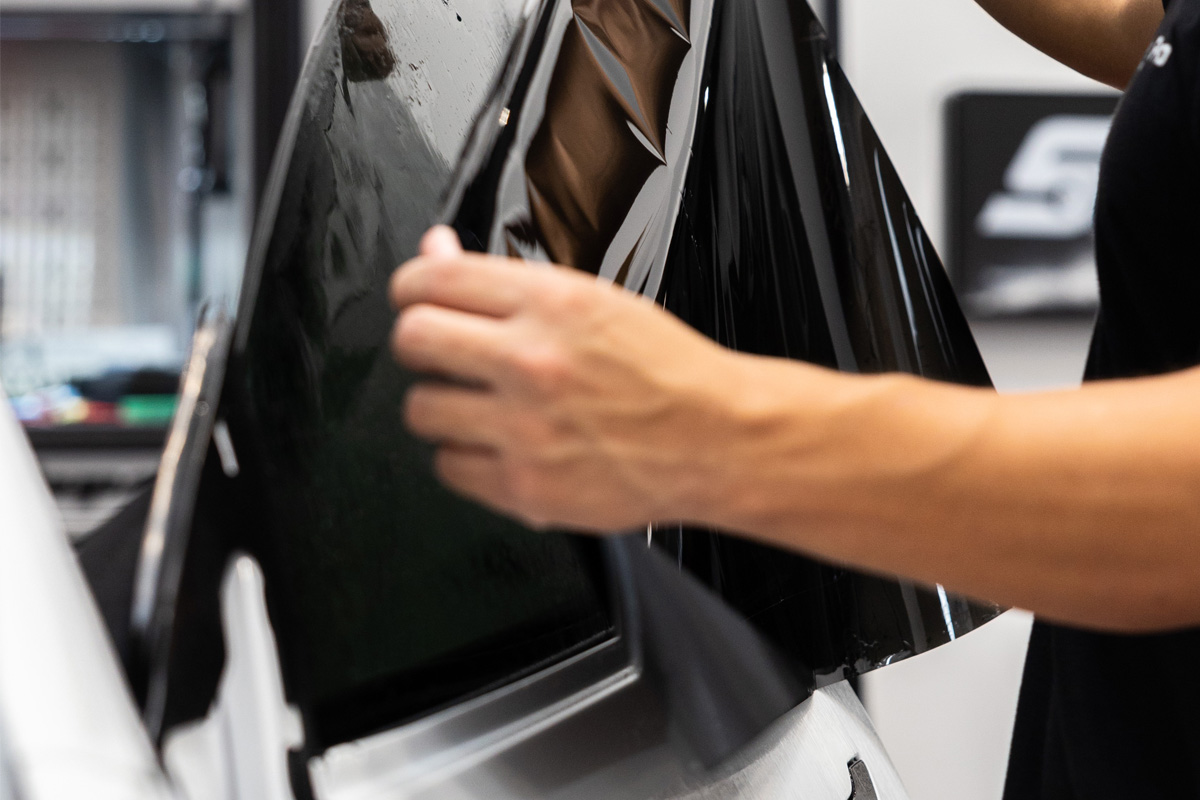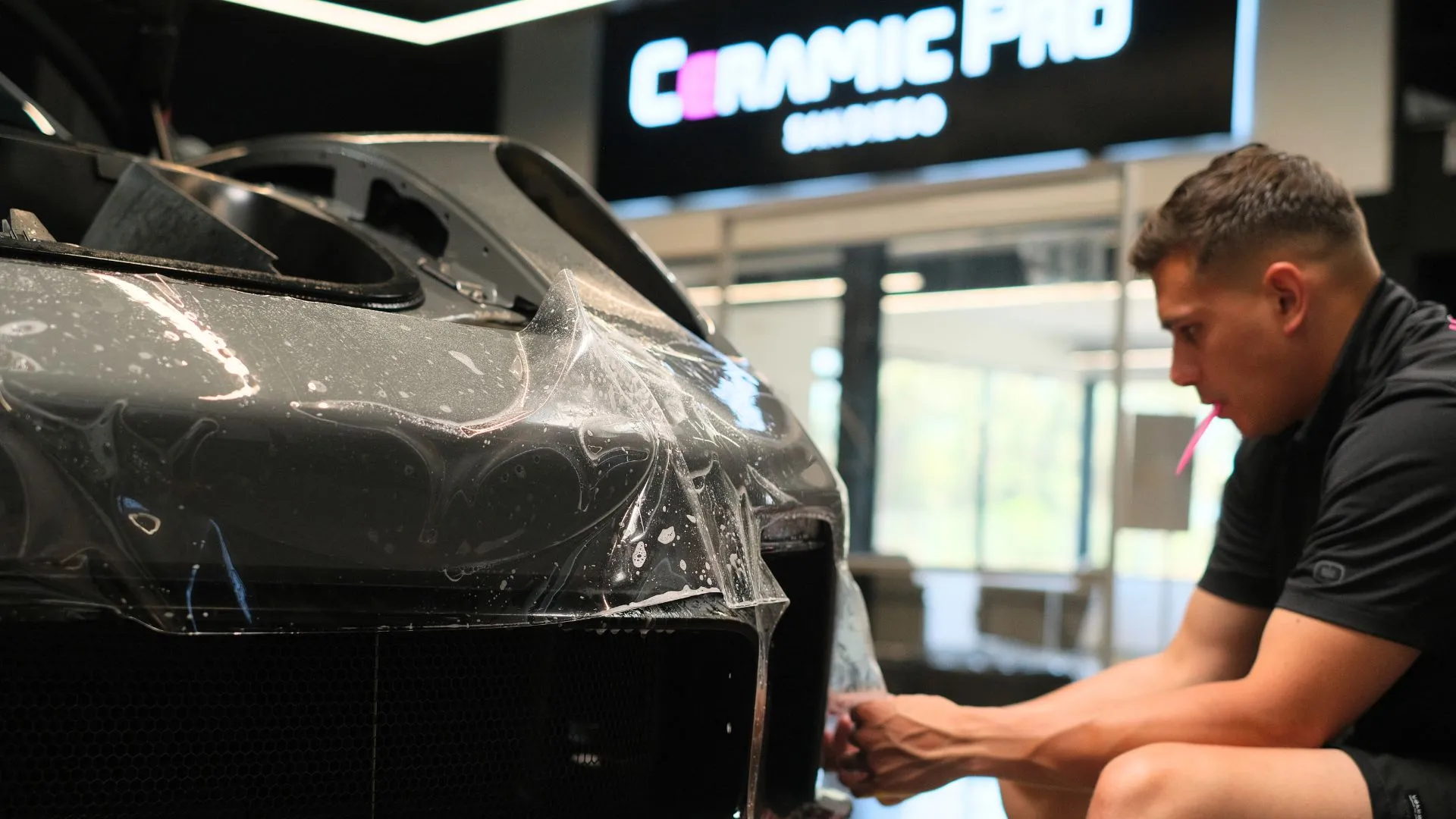

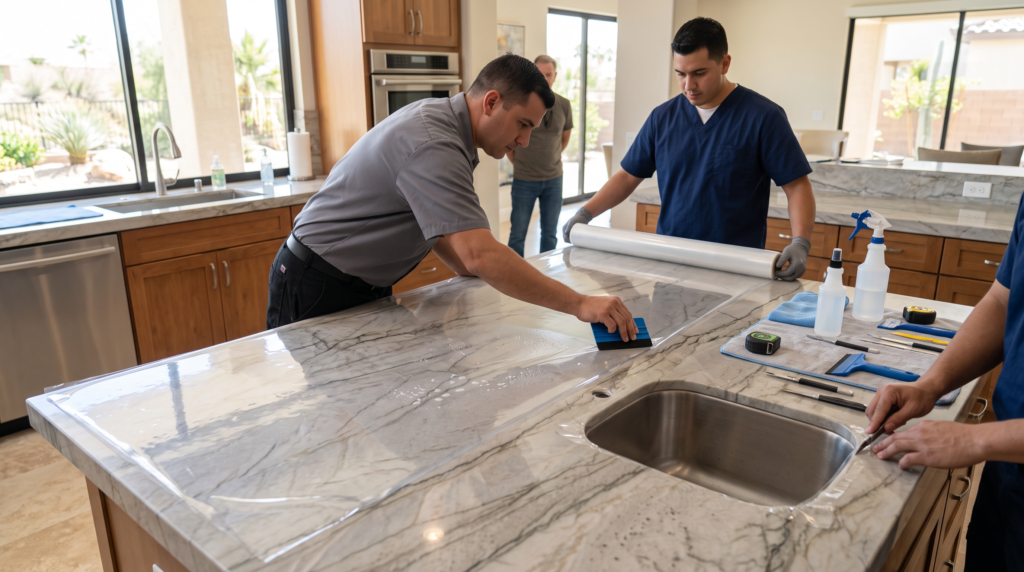
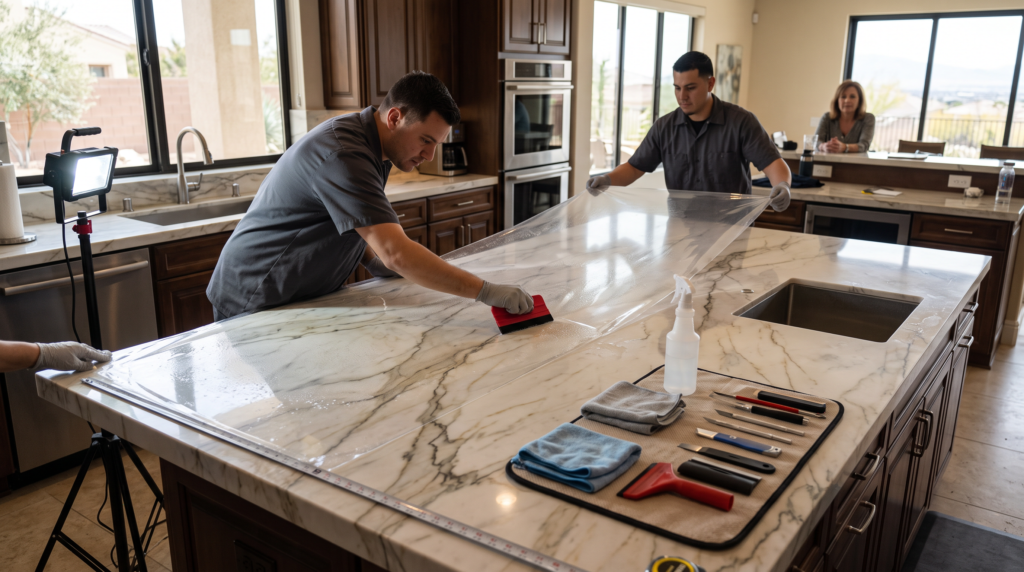
Countertop protection film installers in Las Vegas do much more than place a clear sheet over stone. A proper installation starts with inspecting the countertop, checking the stone and finish, identifying existing damage, measuring each surface, cleaning the substrate, planning seams and cutouts, applying the film with a slip solution, trimming it, and finishing the edges.
That process matters because countertop protection film is transparent.
Any stain, etch mark, scratch, seam, repair, or surface defect underneath the film may still be visible after installation.
Professional installers also need to account for sinks, faucets, cooktops, stone seams, islands, corners, and the exact finish of the countertop.
TuffSkin, which operates a Las Vegas, NV installation service, publishes a defined process for its stone protection laminate. Its 2025 specifications call for inspection of the stone before installation, cleaning away oil, grease, dirt, and other substances that could affect adhesion, and installation only on a smooth, dry, clean surface. TuffSkin also requires its product to be applied by a certified installer.
Ceramic Pro Las Vegas currently publishes automotive services such as paint protection film, ceramic coating, window tint, vinyl wrap, and paint correction. Its current service menu does not list countertop protection film.
If you want to ask Ceramic Pro Las Vegas whether countertop or architectural film work is currently available, call (702) 943-8877 or use the contact page.
For anyone researching countertop protection film installers in Las Vegas, NV, here is how a typical professional installation works.
Long-term countertop protection film is different from the temporary plastic used during construction or remodeling.
Products such as TuffSkin are made to stay on compatible stone surfaces during normal use.
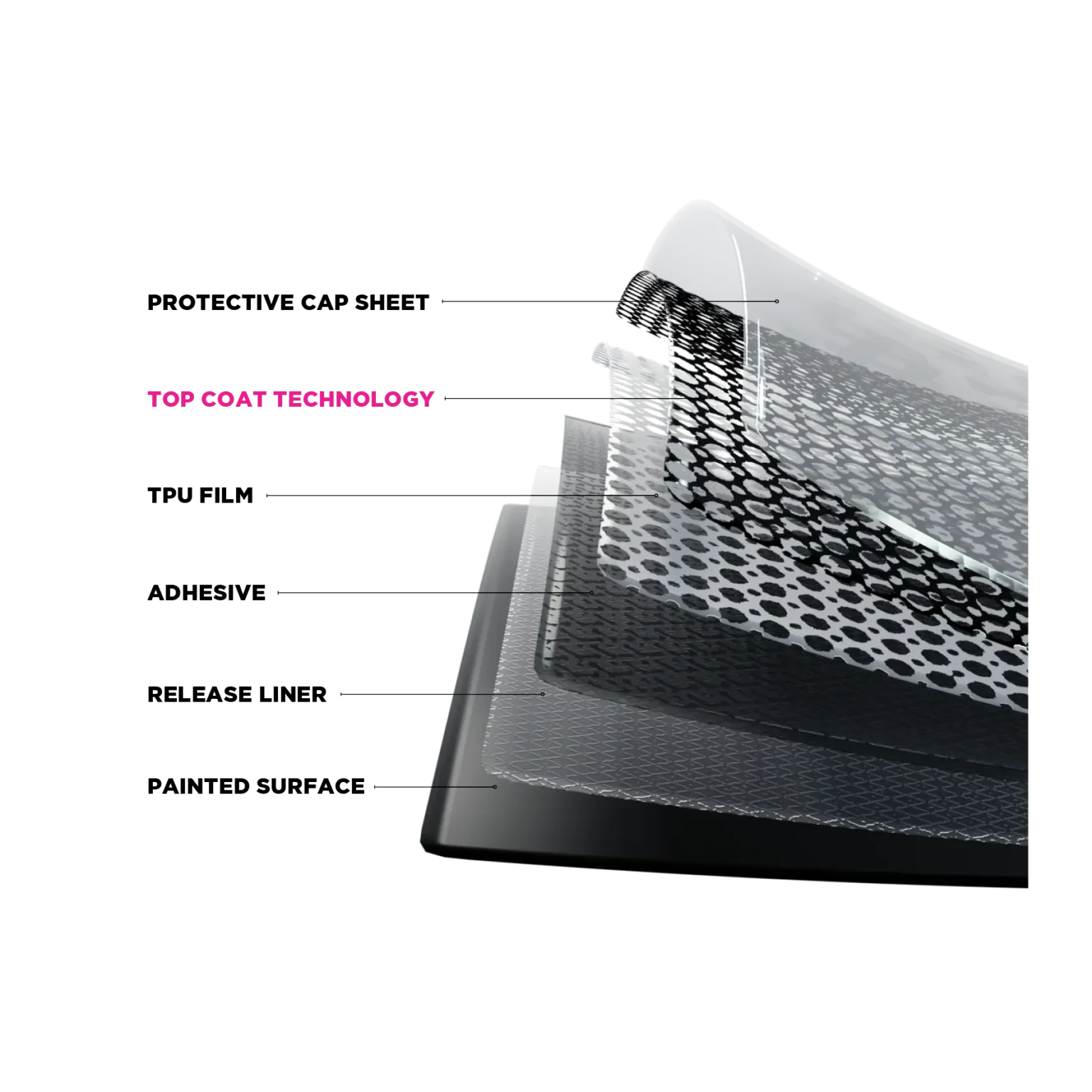
TuffSkin describes its product as a polyester laminate that is gas permeable while blocking liquid from reaching the covered stone.
Its Las Vegas operation advertises installation for residential and commercial stone surfaces, including marble countertops used in:
The film acts as a physical barrier over the stone.
That can be useful on marble and other surfaces where owners are concerned about:
The installation still needs to match the stone and its finish.
A professional installation should begin with an inspection.
TuffSkin’s 2025 specification tells installers to examine countertop surfaces and confirm that they are flat, smooth, and suitable for installation before proceeding.
This inspection may look at:
The installer should also identify whether the finish is polished, honed, satin, or another texture.
That can affect which protection film is appropriate.
Polished marble and similar surfaces usually call for a clear film designed to preserve the glossy appearance.
Honed marble has a softer, lower-gloss appearance.
A satin film may be a better match when the film manufacturer offers one.
Do not assume one clear film is right for every stone finish.
Countertop film does not restore damaged stone.
TuffSkin’s published specifications state that the material is not intended to hide imperfections.
If a stain or defect can be seen before installation, it may still be visible after the film is applied.
TuffSkin notes that an installer can place a test sample over a visible defect so the customer can see whether it remains noticeable.
If the owner wants that defect repaired first, restoration should happen before the film is installed.
Common pre-existing conditions include:
This is one reason a good countertop protection film installer should inspect the actual counter rather than quoting only from rough square footage.
After the stone is inspected, the installer needs accurate dimensions.
Measurements may include:
Large islands need extra attention because film comes in fixed roll widths.
TuffSkin’s current 2025 specification lists roll widths up to 72 inches.
A countertop wider than the available material may need more than one piece.
That makes seam planning part of the installation.
Sink and cooktop openings create some of the most detailed work in a countertop protection film installation.
The installer may need to work around:
Film also needs to account for seams already present in the stone.
TuffSkin’s current application instructions state that its material is applied to each individual piece of natural stone and ends just short of each stone seam.
That means the film does not simply bridge every joint as though the entire kitchen were one solid slab.
Ask the installer how each stone seam will look when the work is finished.
Clean preparation is one of the most important parts of the installation process.
TuffSkin’s 2025 specification says the substrate should be cleaned of substances that could interfere with bonding.
That includes:
The manufacturer calls for a smooth, clean, dry surface without defects that would interfere with installation.
Why does this matter?
Because contamination underneath transparent film can remain visible.
Grease can also interfere with the adhesive.
The goal is to place the film against properly prepared stone, not against leftover cooking residue or cleaning products.
You can keep the surface reasonably clean before the appointment, but let the installer handle the final prep.
Do not cover the stone with fresh waxes, polishes, oils, or another treatment right before installation unless the film installer tells you to.
Those products may have to be removed before the film can bond correctly.
Professional stone protection film is not simply dropped onto a dry countertop.
TuffSkin’s published installation process says a slip solution is sprayed onto the stone before the laminate is positioned.
The liquid lets the installer move the film while lining it up.
This helps with placement around:
A wet application process also gives the installer time to reposition the material before it is fully set.
This part may look similar to installing certain other films, but the product and surface are made for countertop use.
Automotive PPF and stone protection film should not automatically be treated as interchangeable materials.
Once the surface and film are wet with the approved solution, the installer positions the material over the stone.
Placement matters because the finished film should sit neatly around fixtures and align with the countertop shape.
The installer needs to avoid:
TuffSkin’s specification calls for a smooth, wrinkle-free, bubble-free finished installation.
Film placement can take more time around a detailed countertop than it does on a plain rectangular slab.
Once the film is positioned, the installer works the slip solution and trapped air toward the edges.
This seats the laminate against the stone.
The installer needs to work carefully around:
Some small pockets of moisture can still appear after installation.
TuffSkin’s published application information states that occasional air or water bubbles can form beneath its product after application and that trapped water can evaporate on its own.
That means a small temporary moisture pocket does not automatically mean the installation has failed.
Ask the installer what is normal for the exact product being used.
After the film is positioned, excess material needs to be trimmed.
TuffSkin describes this stage as trimming the excess laminate and finishing the edges.
This is where installer skill becomes easy to see.
Look at areas around:
Cuts should look controlled and consistent.
The installer should also avoid damaging the stone while trimming.
A common misconception is that countertop film wraps around every stone edge like automotive PPF can wrap around certain body panels.
That is not how every stone film works.
TuffSkin’s current 2025 application document states that its material is installed on the flat surface only and is not wrapped around countertop corners or edges.
The manufacturer says the film is cut at a slight angle near the stone edge to reduce the chance of snagging.
That means owners should ask to see an edge sample before hiring an installer.
Understand:
TuffSkin also warns owners not to pick at its edges because the material can be pulled up.
A freshly installed countertop film may need time for remaining moisture to clear.
The exact appearance depends on:
Ask the installer what you may see during the first day or days after installation.
Do not start pressing on edges or trying to remove small bubbles without guidance.
The installer should explain which changes are expected and which ones require a return visit.
Different manufacturers publish different claims, so check the product being quoted.
TuffSkin describes its stone laminate as protection against:
Its Las Vegas service page advertises a 10-year warranty against etching and staining under its terms.
TuffSkin also publishes a heat resistance rating of up to 400 degrees Fahrenheit for its product.
Those figures apply to TuffSkin.
Do not assume every countertop film carries the same warranty, heat rating, or material construction.
Film has limits.
It should not turn a countertop into a cutting board.
TuffSkin’s care instructions warn against cutting directly on the surface because doing so can scratch the laminate.
The company also warns against abrasive cleaners.
Even when a product carries a published heat rating, using a trivet remains a sensible way to protect both film and countertop.
Countertop film also does not repair:
Those concerns should be handled before installation when needed.
The visual finish deserves attention before installation begins.
A polished marble countertop and a honed marble countertop should not necessarily receive the same-looking laminate.
Ask the installer to show samples on stone similar to yours.
Look at the sample:
You want to see how the film changes:
Do not approve a film solely from a photograph if appearance matters strongly to you.
A physical sample can be much more useful.
Large islands can be some of the more involved countertop film installations.
Their size can create:
If the island is wider than the film roll, ask where the film seam will go.
TuffSkin’s current specification lists material up to 72 inches wide.
That width may allow many surfaces to be covered with one sheet, but very large islands can still require a planned seam.
Ask the installer before assuming vertical waterfall panels are included.
TuffSkin’s published application instructions state that its film is installed on the flat surface of natural stone and is not wrapped around corners or edges.
That means a waterfall side should be discussed as its own surface rather than assumed to be part of the horizontal top installation.
Get the exact coverage in writing.
Installation time varies with the job.
Factors include:
A simple bathroom vanity and a large commercial stone installation should not be expected to take the same amount of time.
Ask the installer for the expected appointment window after the surfaces have been inspected or measured.
If the stone already has visible etching or wear, restoration may be worth discussing.
TuffSkin Las Vegas advertises stone restoration along with its surface protection service.
That can matter because transparent film may allow defects underneath to remain visible.
If the owner wants the stone to look better before it is covered, restoration should happen before film application.
Ask whether:
Do not assume film itself will hide damage.
When comparing countertop protection film installers in Las Vegas, ask the same questions of each company.
Get the actual manufacturer and product name.
TuffSkin’s current specifications require application by a certified installer.
Other manufacturers may have their own installer requirements.
Ask about your exact countertop.
Do not settle for “it works on stone.”
Polished and honed surfaces may need different products.
Ask whether film stops at each stone seam.
Ask whether the product wraps edges or ends on the flat surface.
Large islands may exceed available roll width.
Visible etching or scratching may remain visible underneath transparent film.
Get warranty terms in writing.
Ask what cleaning products and tools the manufacturer allows.
No.
Both products are films, but their intended surfaces and use conditions differ.
Automotive paint protection film is made for vehicle paint, exterior weather exposure, road debris, and automotive washing.
Stone protection film is made for compatible countertop surfaces and kitchen or commercial interior use.
A product made for marble countertops should have documentation supporting stone installation.
Do not assume leftover automotive film is the same product.
Ceramic Pro Las Vegas currently publishes an automotive service menu.
Its current services include:
The current published service pages do not list countertop protection film.
If you want to ask whether Ceramic Pro Las Vegas currently accepts countertop or other architectural film projects, call (702) 943-8877 or visit the Ceramic Pro Las Vegas contact page.
The shop is located at:
8540 Dean Martin Dr. Ste 170, Las Vegas, NV 89139
Business hours are Monday through Friday, 9am to 6pm.
For a confirmed dedicated countertop installation service, TuffSkin currently publishes a Las Vegas, NV operation specializing in natural-stone protection film and stone care.
The installer first checks that the countertop is suitable for film. TuffSkin’s current installation specification calls for a smooth, dry, clean surface and removal of oil, grease, dirt, mold, mildew, and other substances that could interfere with bonding.
TuffSkin’s published installation process uses a slip solution on the stone before the laminate is positioned. The solution allows the installer to align the material before working liquid and air out from beneath the film.
Not every product does. TuffSkin’s current application instructions state that its film is installed on the flat stone surface and is not wrapped around countertop corners or edges. Ask the installer how the specific film you are buying is finished.
Not necessarily. TuffSkin states that its product is not made to hide imperfections. Existing stains, scratches, etching, or other marks may remain visible after installation. Restoration can be discussed before film is installed.
TuffSkin states that occasional air or water bubbles can form after installation and that trapped water can evaporate on its own. Ask your installer what is normal for the product and when you should call if an area does not clear.
Follow the film manufacturer’s directions. TuffSkin warns against abrasive cleaners and cutting directly on its laminate. Ask your installer for approved cleaning directions before the appointment is finished.
Look for an installer trained or certified by the film manufacturer, then ask about stone compatibility, surface prep, seams, edge treatment, warranty, and care directions. TuffSkin currently operates a dedicated Las Vegas, NV stone protection service. Ceramic Pro Las Vegas does not currently list countertop film among its published automotive services, so call (702) 943-8877 or use the contact page if you want to ask whether that service is available.
Tell us about your vehicle, daily driving, and goals so we can recommend the best package for protection and style. Share the services you want to compare, such as paint protection film, ceramic coating, window tint, vinyl wrap, or paint correction. Include your timeline and any photos that show panels, glass, or problem areas. The more details you provide, the more precise our estimate and scheduling will be.
Explore the many services we offer by clicking the boxes below